 By Coco
Glass railing fixing points connect the visible hardware to a supporting structure that may be hidden by finishes. Choosing a base plate is only one part of that connection. This Foundry Queen guide explains how to assemble the information needed for a project-specific review, without treating a hardware catalogue as a structural design.
Follow the load path through the finishes
Start at the glass and trace the intended connection through the fitting, fixing and supporting member. Identify which layers are structural and which are decorative, waterproofing or leveling materials. A neat finished floor does not reveal the condition or thickness of the substrate below it.
For a balcony, the connection may also interact with waterproofing and drainage. Record these layers on a section drawing. The fixing designer needs to know the actual arrangement before specifying an attachment, rather than discovering a concealed membrane during installation.
Record the edges and obstructions
Mark the available fixing area, nearby edges, joints, openings and services. Include dimensions from an agreed reference so that different trades are discussing the same location. A photograph is useful context but does not replace a dimensioned survey.
Avoid selecting a universal anchor from a hardware image. Anchor type, embedment, spacing and edge requirements depend on the supporting material and project design. The responsible engineer or approved fixing specialist must settle those details for the actual installation.
Compare mounting arrangements honestly
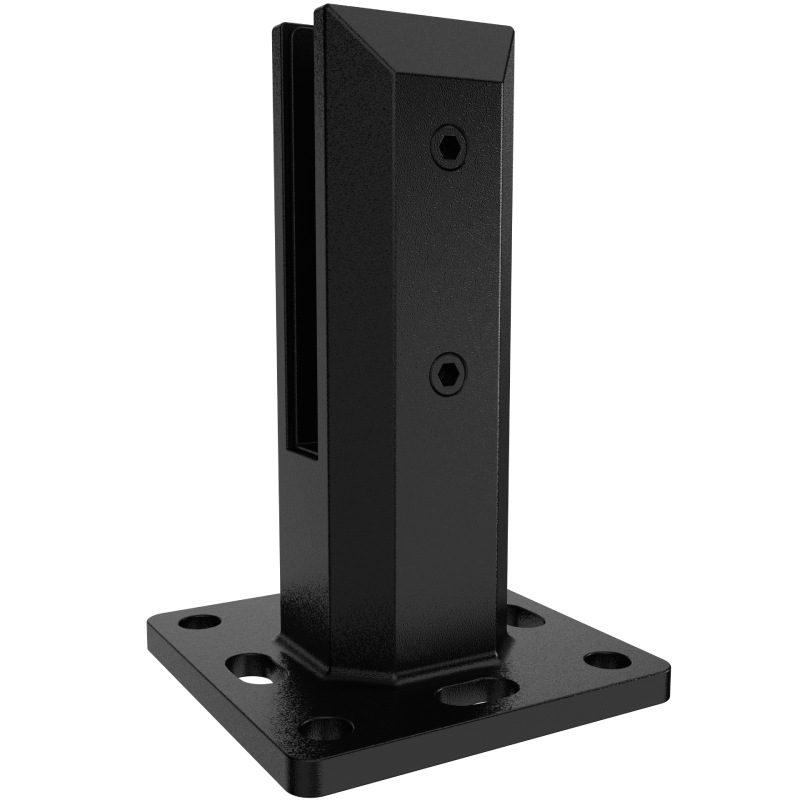
A surface-mounted spigot and a core-mounted spigot impose different preparation and access requirements. A side-mounted fitting may change the relationship between the panel, slab edge and usable floor area. Compare the full connection, not just the visible size of the fitting.
Our square surface mount glass spigot and LS-ASC core mount spigot illustrate distinct product arrangements. Their inclusion in a catalogue is not evidence that either is suitable for an unreviewed slab.
Plan installation and future access
Ask how the fitting will be positioned, aligned and inspected before cover plates conceal the connection. Coordinate the sequence with glass delivery and the completion of surrounding finishes. An assembly detail that is practical in a workshop may be inaccessible at the installed location.
Future access matters as well. Identify which parts can be removed and what work would be needed to replace a fitting or panel. Keeping drawings and component references in the handover package reduces the risk of destructive investigation when maintenance is required.
Example: a fixing through a finished balcony floor
A surface photograph may show enough room for a base plate while concealing a thin topping, membrane and structural slab below. The fixing decision needs a section identifying those layers and the actual structural support. Coordinate the attachment and waterproofing detail before drilling. This hypothetical example does not prescribe an anchor; it explains why the hardware supplier needs more information than the finished floor dimensions.
Make the enquiry package usable
Provide the railing layout, panel references, substrate information, mounting sections and relevant project requirements. Distinguish surveyed dimensions from assumptions that still need verification. Ask each party to identify the information they are responsible for approving.
A manufacturer or supplier can then respond to a defined product request, while the project team retains responsibility for the complete connection. Separate product price, anchoring, installation, engineering and site testing in the quotation so that a lower figure does not conceal a missing part of the work.
Enquiry checklist
| Input | Why it matters |
|---|---|
| Substrate section | Shows structural material and concealed layers |
| Fixing layout | Locates edges, joints, holes and access |
| Responsibility schedule | Identifies who approves hardware, anchoring and installation |
Explore Foundry Queen construction hardware, then send a coordinated drawing set through our enquiry page. Product selection should follow the actual fixing conditions.
Technical reference
CRL: example of model-specific spigot documentation. This reference provides technical context; it does not establish Foundry Queen certification or project approval.
Get Premium Casting Products
Join FoundryQueen.com Newsletter to get more information of different premium OEM Casting products in China.